23 August to 04 September 2013
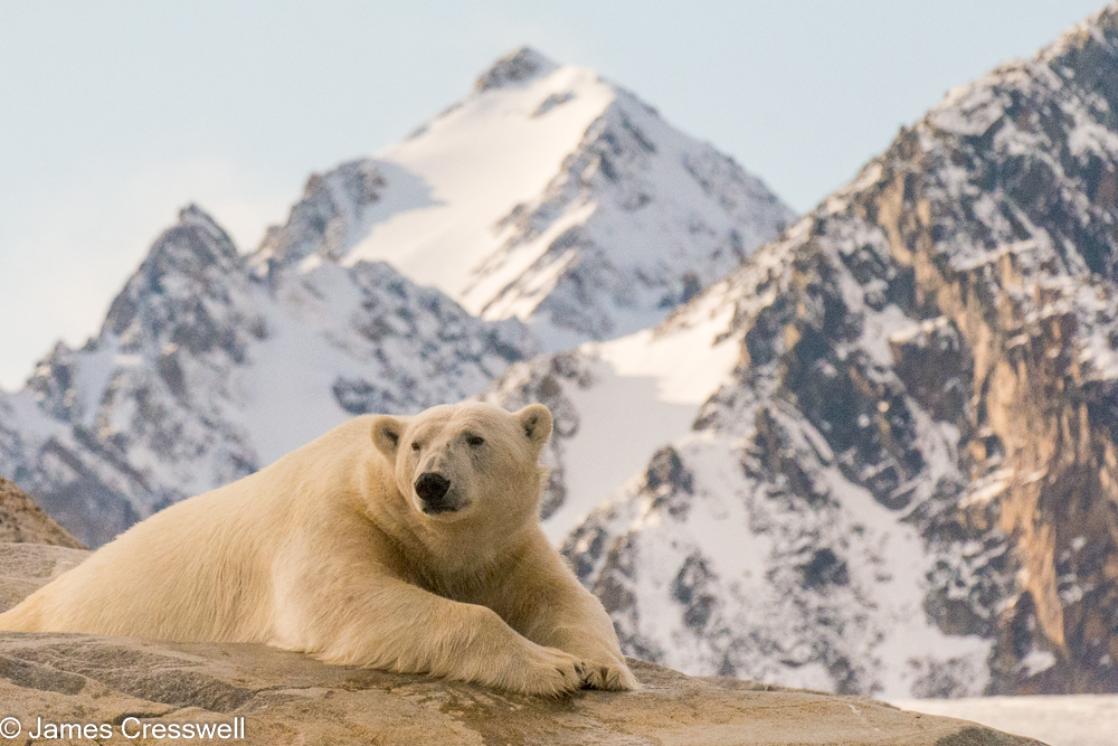
East Greenland is a truly awe inspiring destination. There is an almost complete sedimentary succession stretching back for the last 1.5 billion years. Due to the incredible completeness of this record many of the Earth’s most important stories can be seen on this trip. On top of this the story is set in draw dropping scenery, with the Northern Lights and wildlife such as the Polar Bear and Inuit Culture. Key geological features that can be seen on this trip include 3 billion year old basement rocks, 1,900 m high stripy cliffs formed from 900 million years old sediments, Devonian sandstone where the famous fossils that link the amphibians to fish were found, Mesozoic rocks that have revealed dinosaurs and ammonites, columnar basalt in the lava flows from the splitting of the Atlantic and amazing icebergs and glaciers. |
|
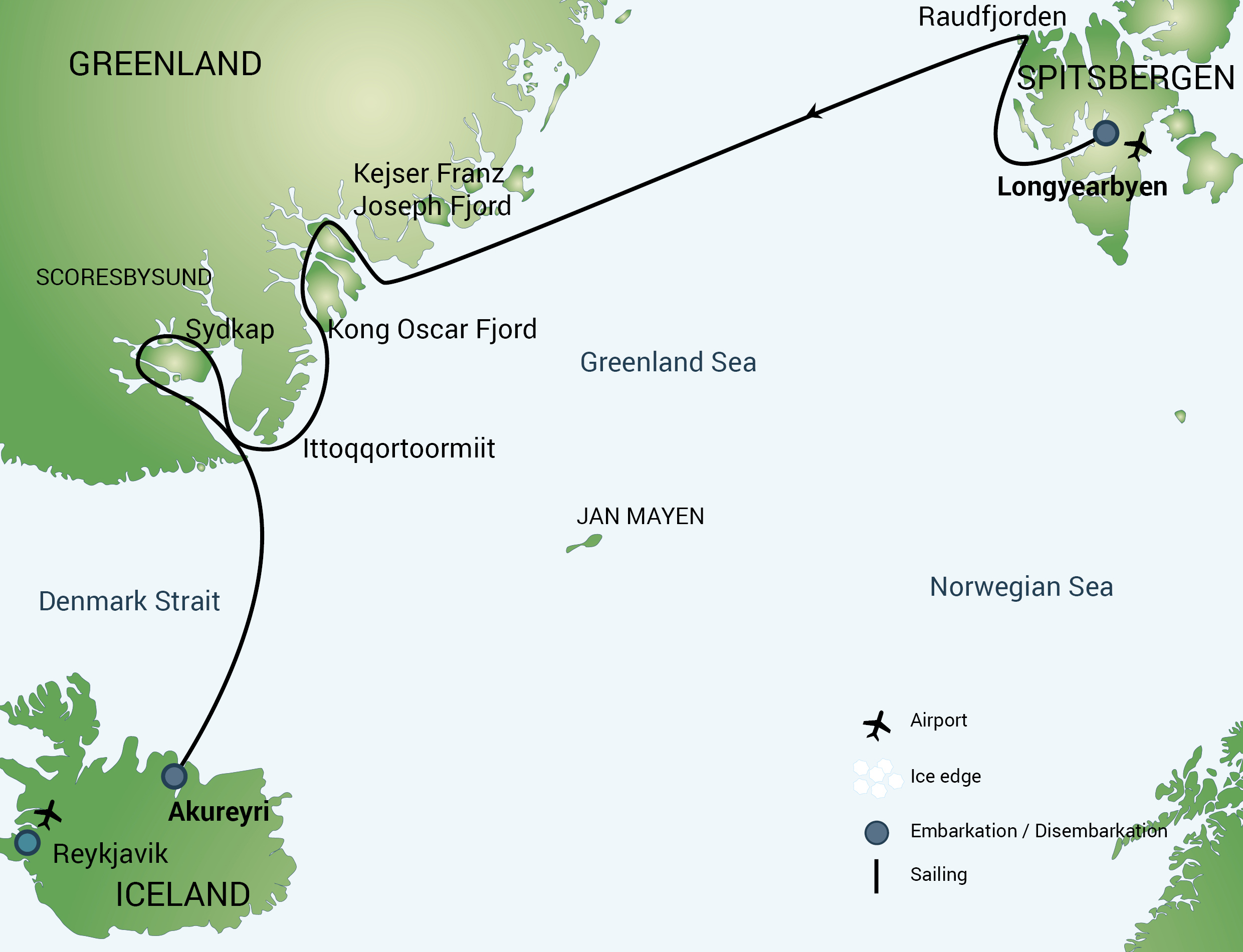
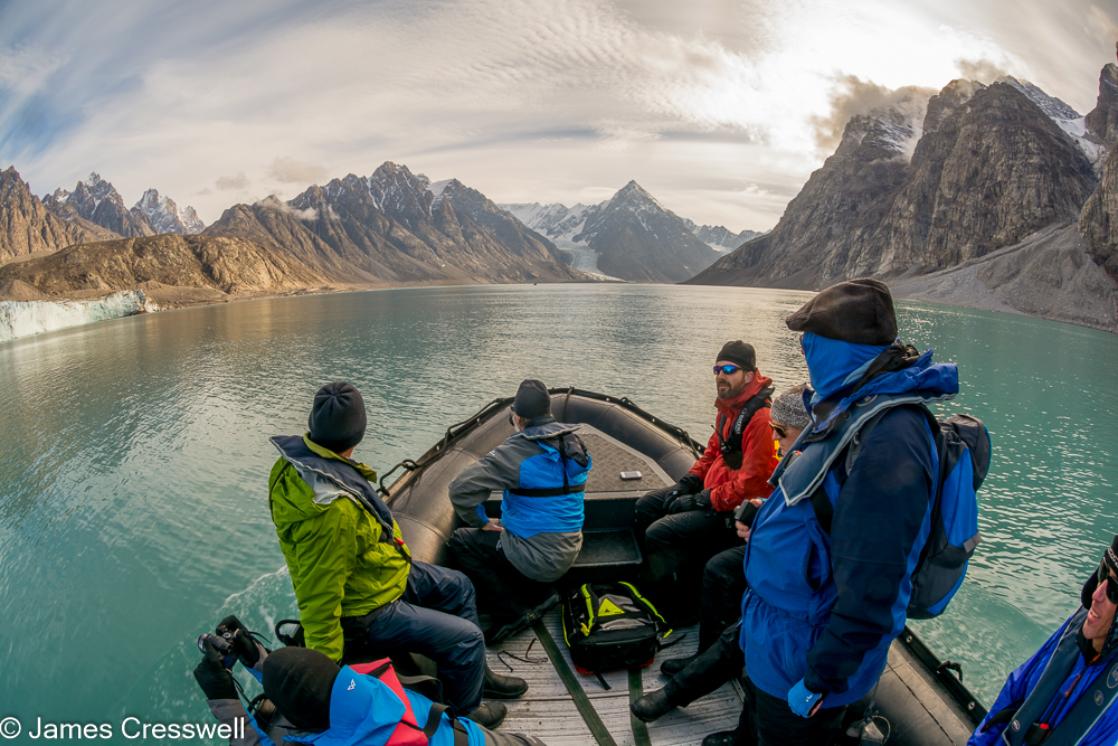
![]() Copyright Oceanwide Expeditions ![]() Geo-tourists admire the scenery of Øfjord. ![]() 1900 m high cliffs of the Elenore Bay Formation ![]() Geo-tourists admire an iceberg. ![]() Precambrian stromatolites. ![]() Geo-tourists examine alternating bands of limestone and dolomite. ![]() Eleonore Bay sediments in Antarctic Sound. ![]() Grundtvigskirche in Øfjord. ![]() Augen granite and orthogneiss bands. ![]() Sills in Jurassic sediments, Hurry Inlet. ![]() A Geological sketch map of East Greenland ![]() The Northern Lights ![]() A basalt dyke cuts through Permian sediments | Day by day ItineraryAll itineraries are for guidance only. Programs may vary depending on local ice and weather conditions and in order to take advantage of opportunities to see wildlife. Flexibility is paramount for expedition cruises. Day 1 - Arrive in Longyearbyen, on Spitsbergen, the administrative capital of the Spitsbergen archipelago of which West Spitsbergen is the largest island. Before embarking there is an opportunity to visit this former mining village. The Parish Church and the Polar Museum are well worth visiting. In the early evening the ship will sail out of Isfjorden. Day 2 - We sail into Raudfjord on the north coast of West Spitsbergen, a beautiful fjord with spectacular glaciers. It is home to Ringed and Bearded Seal, seabird colonies and a surprisingly rich vegetation. We have good chances to see Polar Bear, for instance near Hamilton Glacier, or more to the head of the fjord. From there we continue to Moffen Island on which Walrus haul out. Day 3 & 4 - At sea, on our way to Greenland, we may see the edge of the East Greenland sea-ice. We keep watch for whales, and also for migrating seabirds. Day 5 - Approaching Greenland we will attempt to sail through the sea ice into Foster Bugt, making our first landing at Myggebugten. Beyond the old hunters’ hut (in the first half of last century Norwegian trappers hunted here for Polar Bear and Arctic Fox) there is an extensive tundra populated by Musk Oxen. The small lakes are home to geese. We sail through Kaiser Franz Joseph Fjord, a magnificent fjord with towering mountains on both sides, its inner reaches choked with huge icebergs. An alternative is Sofia Sund, which is much narrower, and where we can see Musk Oxen from the ship. Day 6 - We will land at Blomster Bugt to view the beautiful geological formations. Arctic Hare are usually seen here, and there is a lake with Great Northern Diver and their young. In the afternoon we sail along Teufelschloss and Ella Ø and may land at a beautiful spot in the early evening. Day 7 - The first half of the day we spend in Antarcticahavn, a wide and extensive valley where we also could see groups of Musk Oxen. At this time of year the autumnal colours of the sparse vegetation make the landscapes even more beautiful. Day 8 - Today we reach the Scoresby Sund and sail in the morning along the ragged and glaciated Volquart Boons. Here we may organise a zodiac cruise along one of the glacier fronts of this coast, and have our first landing near for instance Maane Glacier. Later we land on Danmark,Ø where we find the remains of an Inuit settlement abandoned around 200 years ago. The circular ‘tent rings’ of stones indicate the summer houses, while the winter houses can be seen closer to a small cape. The sites are well preserved, allowing entrances and even bear-proof meat caches to be identified. There are also grave sites. In the evening we continue our sailing through the beautiful fjords to the west, choked with icebergs. Day 9 - We go ashore at Cape Hofmann Halvø, a reliable spot for viewing Musk Oxen. We may also spot Rock Ptarmigan and Great Northern Diver at sea. The landscape here is particularly beautiful, especially during autumn when the Dwarf Willow and Dwarf Birch change colour. Arctic Blueberry and Crowberry add their own colourful touch - the berries are tasty too! In the evening we sail through the fjord towards Scoresby Land, enjoying the contrast between the warm autumnal colours of the vegetation on shore, backed by huge dark mountains, and the cold blue of the icebergs. Day 10 - In Northwest fjord in Scoresby Land in the morning, we encounter huge icebergs, some over 100m high and more than a kilometre in length. Most of the bergs are grounded as the fjord is only about 400m deep here. We land near Sydkap to view the remains of the Thule culture winter houses. As many as 20 people lived in these tiny houses, hunting Greenland Whale and using their vertebrae to build the houses. We may also land at Gurreholm on Jameson Land. The landscape here is gently undulating. Day 11 - In the morning we land at Ittoqqortoormiut, the biggest settlement in the Scoresby Sund with about 500 inhabitants. At the post office you can buy stamps for your postcards, or just wander around to see the sledge dogs and the drying skins of Seal, Musk Ox and Polar Bear. After dinner we will sail south passing the amazing landscape of the Blosseville Coast. Day 12 - We will spend the whole day at sea and we will have splendid opportunities to see large whales and seabird migration and, in the night, the Aurora borealis (Northern Lights). Day 13 - In the morning we arrive in Akureyri and are taken by a chartered bus during a 6 hours drive through North Iceland to our hotels in Reykjavik.
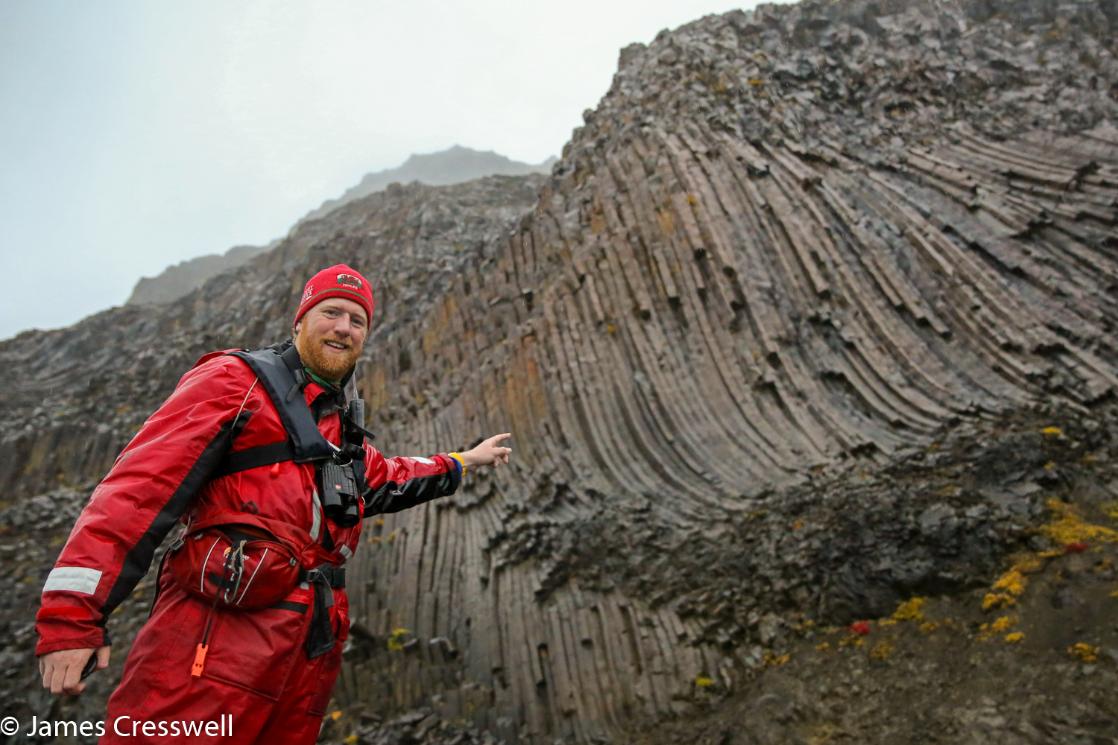
The ice-strengthened vessel “Ortelius” is an excellent vessel for Polar expedition cruises in the Arctic and Antarctica, providing us with possibilities to adventure remote locations such as the Ross Sea and Franz Josef Land. “Ortelius” was built in Gdynia, Poland in 1989, was named “Marina Svetaeva”, and served as a special purpose vessel for the Russian Academy of Science. The vessel is re-flagged and renamed “Ortelius”. As Plancius, Ortelius was a Dutch / Flemish cartographer. Abraham Ortelius (1527 – 1598) published the first modern world atlas, the Theatrum Orbis Terrarum or Theatre of the World in 1570. At that time, the atlas was the most expensive book ever printed. The vessel has the highest ice-class notation (UL1 equivalent to 1A) and is therefore very suitable to navigate in solid one-year sea ice and loose multi-year pack ice. “Ortelius” is a great expedition vessel for 106 passengers with lots of open-deck spaces and a very large bridge which is accessible to the passengers. The vessel is manned by 34 highly experienced Russian nautical crew, 15 international catering staff, including stewardesses, 6 expedition staff (1 expedition leader and 5 guides/lecturers) and 1 doctor. ”Ortelius” offers a comfortable hotel standard, with two restaurants, a bar/lecture room and a sauna. Our voyages are primarily developed to offer our passengers a quality exploratory wildlife program, trying to spend as much time ashore as possible. As the number of passengers is limited to approximately 106 on the “Ortelius”, flexibility assures maximum wildlife opportunities. "Ortelius" carries 11 zodiacs of which 9 are in use and 2 on reserve. The zodiac engines are 60hp Yamaha. Length: 91,25 meters Breadth: 17,61 meters Draft: 5,8 meters Ice class: UL1 (equivalent to 1A) Displacement: 4575 tonnes Engines: 6 ZL 40/48 SULZER Speed: 12 knots (14,3 knots max) Passengers: 106 in 45 cabins Rates Suite: € 8450 Superior: € 7450 Twin Window: € 6250 Twin Porthole: € 6000 Quadruple Porthole: € 4300 ![]() Columnar basalt cooling structures |
The Geology of East Greenland by James Cresswell
Eighty percent of Greenland is covered by ice, and in places it is up to 3.4 km thick! So, Greenland might not immediately spring to mind as a place to go to observe rocks. However Greenland is huge, and the ice free area at 410 000 km2, is nearly twice the size of the United Kingdom. This ice free area is generally sparsely vegetated leaving the rocks beautifully exposed and the geology incredibly easy to see. The area of East Greenland around Scoresby Sund, Kong Oscar and Kejser Franz Joseph Fjords is the largest ice free area in Greenland. This area also has incredible geodiversity with basement rocks as old as three billion years old, an almost complete sedimentary record of the last 1600 million years and huge volumes of flood basalts from the splitting of the Atlantic. If you were an alien and wanted to try to piece together the geological story of Planet Earth, but could only visit one area, East Greenland would be the place to go!
The geological history of Greenland is vastly long and spans 3.8 billion years. The oldest rocks in Greenland are 3.8 billion year old Isua Complex, situated in West Greenland near the capital Nuuk. These rocks are the Earth’s oldest well preserved sedimentary and volcanic rocks, and they contain carbon particles which most likely originate from the oldest known life on the planet as well. To put it into perspective just how old these rocks are try to imagine that the planet is only 1 year old. It would have formed on January 1st, with the earliest known life and these Greenlandic rocks would have formed in March. Multicellular life did not evolve until October, the dinosaurs a few days before Christmas, going extinct on Boxing Day. Humans only appeared 15 minutes ago, with all of civilisation being in the last 10 seconds!
At the time these rocks formed, our planet was a very different place and the continents were still forming. There was actually less continental crust on the planet than there is now, however there was plate tectonics. When one oceanic plate collided with another, one would be forced to slide under the other in the process called subduction. Minerals in the subducting slab would dehydrate causing the overlying mantle to melt and new rock types, like granites to be produced. These granites are continental crust, and in all subsequent collisions they would not be subducted. Over time the amount of continental crust increased and increased. When pieces of continental crust came into collision, they would weld together to form one block, and the immense forces would thrust up mountain chains. In this process the rocks would buckle and fold, with the intense heat and pressure causing them to transform into metamorphic rocks such a gneiesses.
A large proportion of the rock exposed in Greenland, particularly in the west and south is made of these strongly folded gneissic rocks, that are the eroded down roots of the different mountain belts, now welded together to form a stable coherent block. This block is commonly known as the basement. The coming together of the basement occurred over a huge period of time, spanning 3800 to 1750 million years ago. It was also not a simple process. For example: by 2.7 billion years ago most of west, east and the south of Greenland had formed and were probably part of theorized ancient continent called Kenorland. 2 billion years ago, Kenorland split up and parts of west Greenland rifted apart again, only to come back together 200 million years later. The final stages of basement building occurred from 1800 to 1725 million years ago when Greenland was part of another super continent called Columbia. These youngest basement rocks are seen in south Greenland.
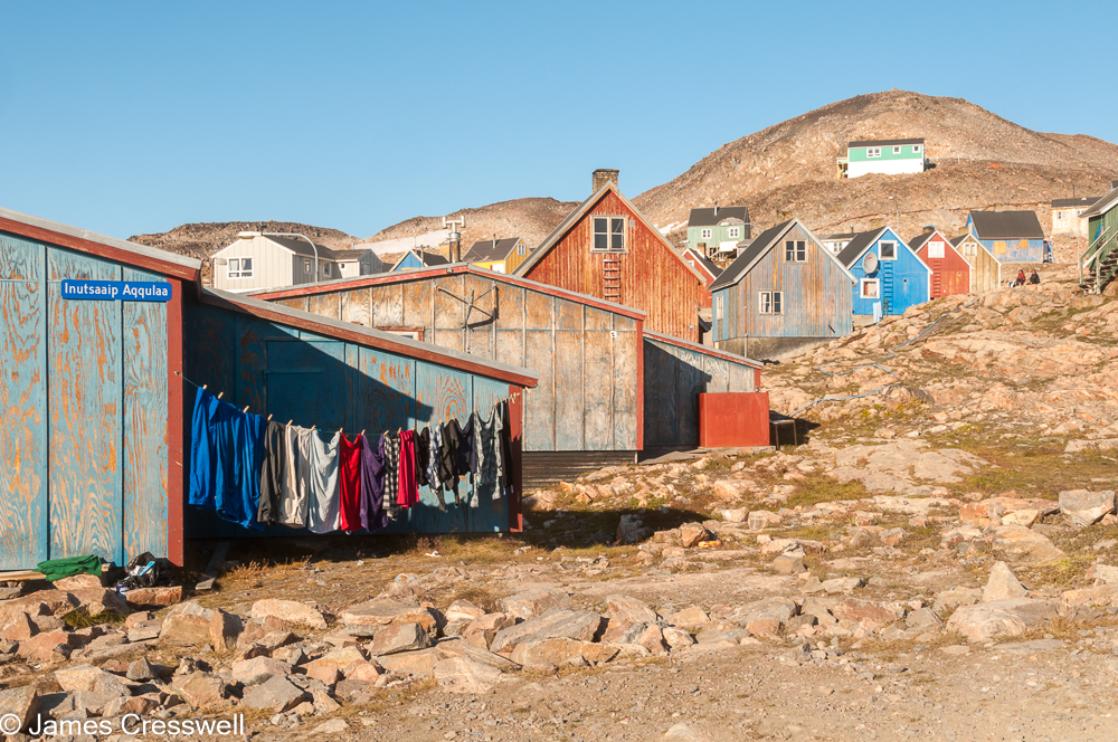
In East Greenland basement rocks are exposed but in most places are covered by younger rocks. The oldest exposed rocks in East Greenland are about 3 billion years old, and occur in the inner most regions of the Scorsby Sund, which is the largest fjord complex in the world. This gneiss is particularly rich in garnets, the large visible red minerals. There is then a time gap to the next oldest rocks in East Greenland. These rocks are also basement gneisses and are 2 billion years old. They outcrop in Liverpool Land and the innermost reaches of Kong Oscar Fjord. Liverpool Land was named by the British whaler William Scoresby who also lends his name to the Scoresby Sund fjord complex and Scoresbysund the alternative name for the settlement of Ittoqqortoormiit. Ittoqqortoormiit is one of the remotest settlements in Greenland and in 2010 had a population of 469. The town was founded in 1925 by the Danish Government who were keen to assert sovereignty over North East Greenland. The area had been the site of Inuit habitation in the past as archaeological remains show.
After the basement had formed in East Greenland there was almost continual sedimentation from 1600 million years ago to the present. The oldest of these sediments, aged from 1.5 to 1.1 billion years old, are the Krummendal rocks. They are up to 8.5 km thick in places and were deposited and transported a considerable distance in a deep ocean environment after the break up of Columbia. Radiometric studies show that the sediments derive from two separate sources with one probably being in what is now North America and the other Europe. Like the oldest gneisses these rocks are only found in the inner most sections of the fjord complexes except for one small outcrop on the northern tip of Liverpool Land. These sediments lie in a thrust sheet, and were trust over the basement in a later mountain building phase. In places the sediments are only lightly deformed but in other places they have been changed into schists which are types of metamorphic rock. Figure 4 shows an erratic made up of Krummedal rock. This rock has been metamorphosed and is now a garnet, kyanite, mica schist.
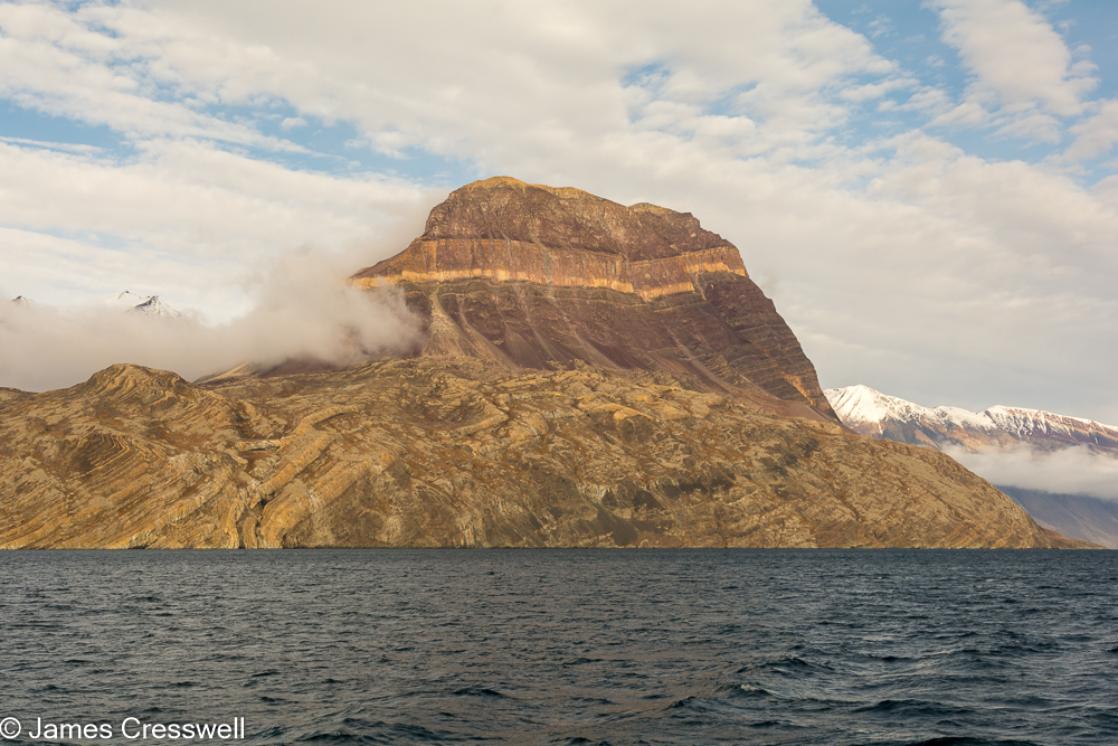
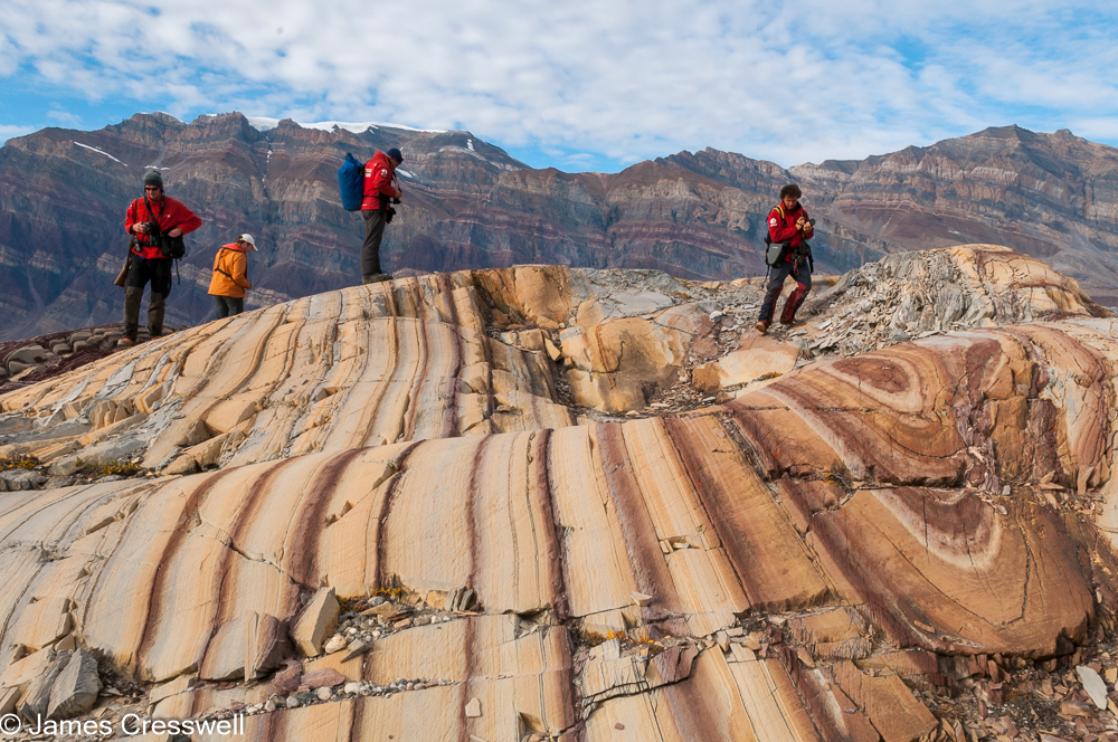
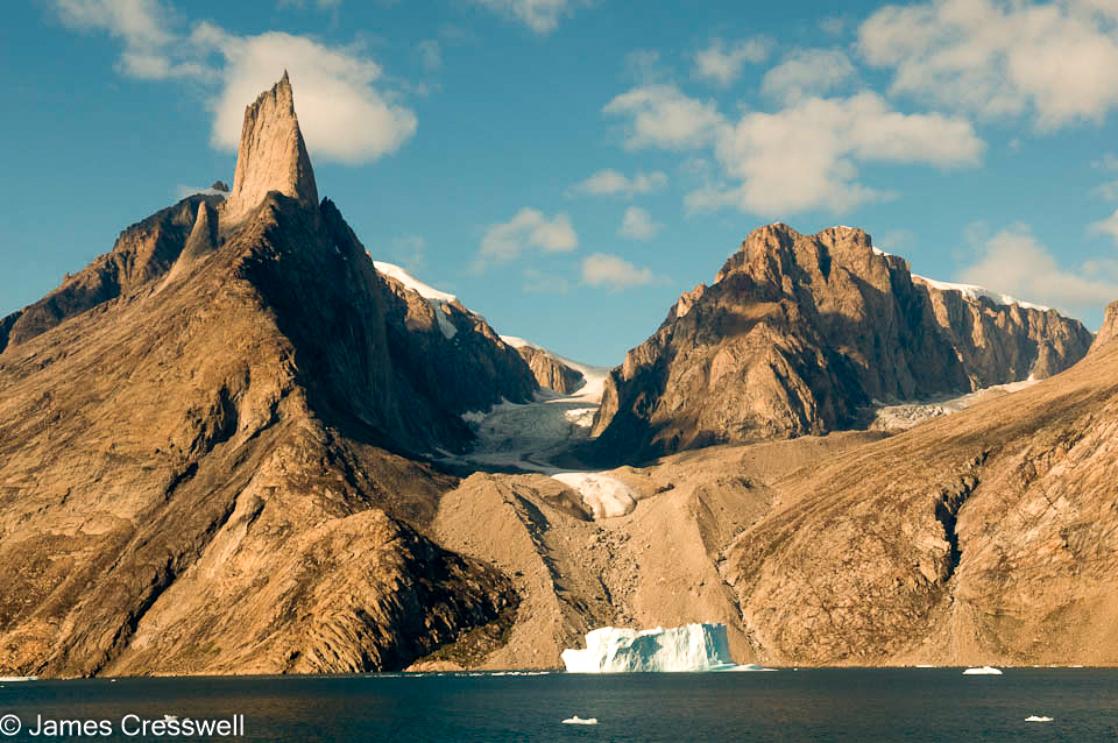
Figures 6 to 10 show photographs of Øfjord. This fjord is spectacular in its dimensions. The fjord is 4 to 6 km wide, but doesn’t feel so due to the enormous height of the valley walls. Figure 6 shows the peak Grundtvigskirche. At 1,977m heigh it towers above the giant iceberg below. The rocks of the fjord are so sheer because they are incredibly hard and have been resistant to the glacial erosion that calved out the main fjord valley. These rocks are also very complex. The red layers are very rich in garnets and are what geologists call a paragneiss. These gneisses have been made from sedimentary rocks, in this case the Krummendal rocks. The white rocks are augen granite. This formed from the complete melting of the Krummedal rocks to form granite. Augen granite is distinguished from other granite types due to its large cystal sizes. Dating of these granites show they formed 900 million years ago (Leslie and Nutman, 2000). This would have been due to yet further continental collisions in the very latest most formation of yet another super continent named Rodinan that existed from 1.1 billion years ago to 750 million years ago.
The complexity of Øfjord does not end here, there are also younger igneous rocks aged from 430-400 million years intruded into the older rocks. These rocks were intruded during the Caledonian mountain building phase, which will be discussed later in the article. Looking at figure 8 the darker rock enclosed by the red line is an intrusion and has been identified by Leslie and Nutman (2000) as a type of rock called a hypersthene monzonite. This intrusion is younger than the red and white stripy rocks above and below it which are the metamorphosed remains of the Krummendal sediments. If you look again at figure 7 which shows the peak of Grundtvigskirche, you will also notice a line of darker rock rising from the bottom left hand corner of the photograph. This is also the same hypersthene monzonite, that cuts through the older metamorphic rock and the top peak of the mountain is also younger Caledonian rock that is a pink granite. Interestingly the sheer face of Grundtvigskirche was first climbed in 2010 by a team of Swiss mountaineers.

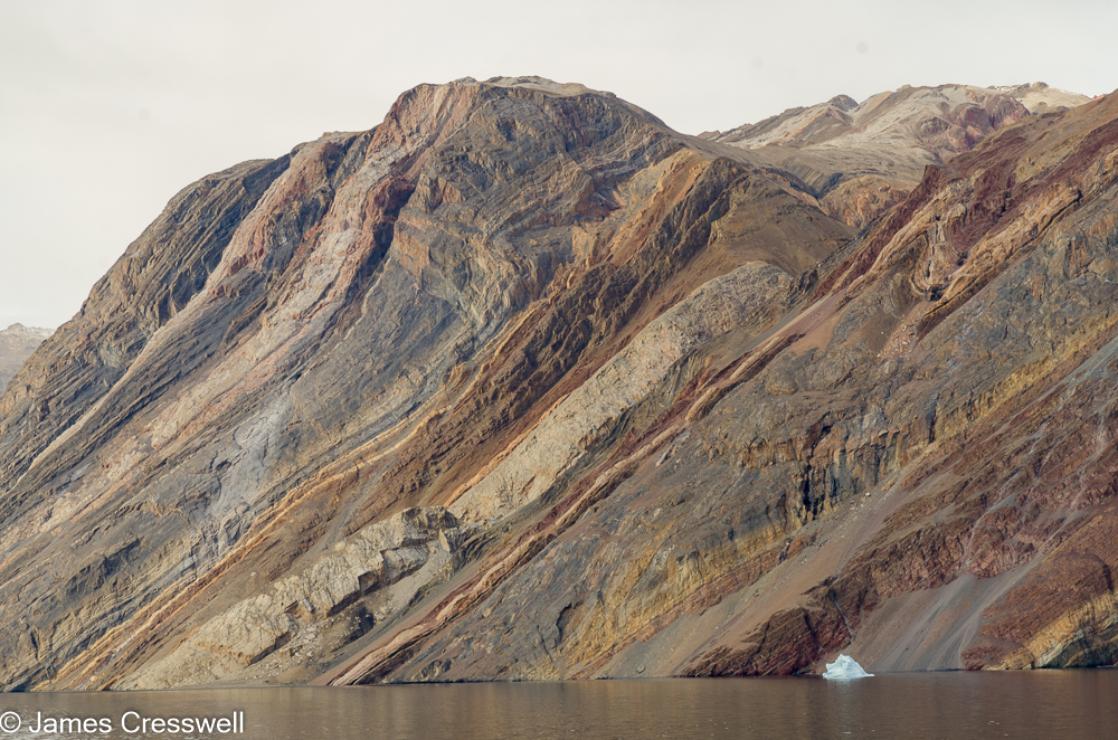
With the super continent of Rodinia established sedimentation began on Greenland’s eastern margin. The scale of this sedimentsation was vast. A staggering 18.5 km thick succession of sediments was continuously laid down from 900 to 450 million years ago! The oldest 14 km of this sequence, the Eleonore Bay group, are the most photogenic rocks in East Greenland, and could well be in contention to be the most photogenic rocks anywhere in the world. The Eleonore bay sediments were lain down in shallow water shelf conditions from 900 to 600 million years ago. Figures 11 and 12 show these sediments forming a spectacular stripy cliff in Segelsällskarpet Fjord. The cliff here is 1900 m high. The multicoloured sediments include fine grained quartzites, mud rocks and different limestones and dolomites. Figures 11 to 18 show various views of the Eleonore bay sediments in Segelsällskarpet Fjord. Figures 19 to 26 show the sediments in as they are exposed in the fjord wall of Antarctic Sound. The uppermost layers of Eleonore bay sediments also contain stromatolite fossils. Figure 27 shows some of these stromatolites. Lying immediately on top of the Eleonore bay sediments are ice age deposits called tillites from the Vendian about 600 to 542 million years ago. At this time Greenland was in a near South Polar position, so perhaps there is nothing unusual about having tillites deposited at this time, but these tiliites interesting correspond to the time when it is thought there may have been a global glaciation called Snow Ball Earth. At this time it is thought all the world’s continents may have been covered by glacial ice and all the ocean by sea ice. It is thought this global glaciation was caused by the break up of the super continent Rodinia.
The Vendian tillites are well exposed on Ella Ø as are Cambrian and Ordovician sediments that overlie them. As Rodinia split, an ocean formed between East Greenland and Europe. This ocean was called the Iapetus, and is the very same ocean that plays an important part in the story of British geology, with England and Wales being on one side of the ocean while Scotland with Northern Ireland were on the other and joined to Greenland. In this ocean the sedimentation continued through the Cambrian and Ordovician, depositing the rocks of Ella Ø and because multicellular life diversified in the Cambrian, these rocks contain many fossils.
The next stage in the story of East Greenland is the closing of the Iapetus ocean which closed 420 million years ago. The closure of this ocean thrust up a chain of mountains probably as high as the modern Himalayas. This mountain chain ran from Svalbard in the north along the coasts of Norway and Greenland, through the UK and into Canada and the USA. The mountain building phase is called the Calaedonian orgongeny which takes its name from the Scottish mountains that if formed. The force of this collision caused older sediments of East Greenland to be folded and thrust up in great sheets over the basement and the intrusions seen in Øford were emplaced. Figure 26 shows the folding in the Elenore Bay sediments due to this collision.
When a mountain chain is thrust up, it will eventually be eroded down again causing sediments to be deposited. A 10 km thickness of sandstone was deposited throughout the Devonian, Carboniferous and lower Permian in East Greenland due to the erosion of the Caledonian mountains.
These sediments were deposited in continental conditions with rivers flowing over otherwise an otherwise arid landscape. The sediments are red in colour due to the iron mineral haematite. The red rocks of the Devonian are known as the Old Red Sandstone, and also outcrop in the Brecon Beacons of Wales, the Orkney Islands as well as Svalbard and parts of the USA. The Devonian sandstone of East Greenland is very fossiliferous and over 10,000 fish fossils have been recovered from it. The most important and famous of these fossils were found in Kejser Franz Joseph Fjord. Evolutionary theory states amphibians evolved from fish, and reptiles, birds and mammals all later evolved from amphibians. In order the prove this it would be great to find fossils that show this process in action, and this is exactly what has been found in this part of East Greenland. Fossils of fish have been found that have four legs and are in fact half amphibian and half fish. Several different species of these four legged fish have been found and they are divided up into two genera: Icthyostega which has a fish like skull and Acanthostega which has a skull with spikes.
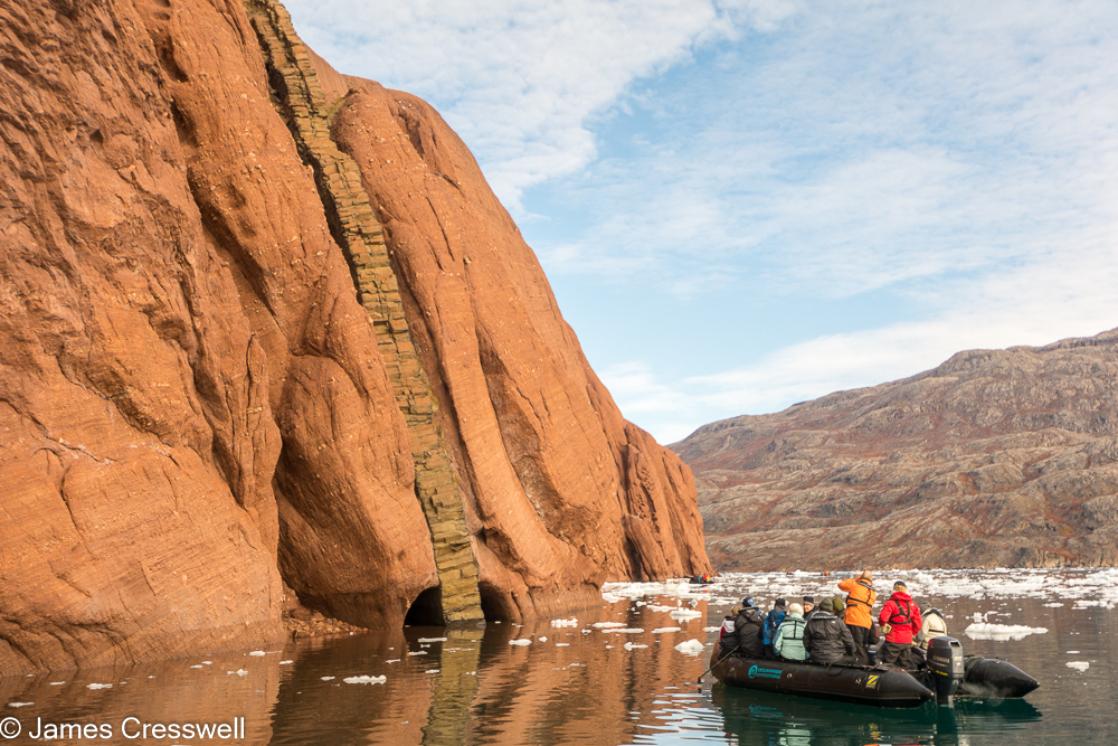
By the time of the Carboniferous and Permian the most recent super continent, Pangaea had come into existence, and rivers continued to deposit red sediments. Figure 28 shows red Carboniferous sediments in Kong Oscar Fjord. Figure 29 shows red Permian sediments in RØdefjord which means red fjord. Figures 30 to 32 also show these Permian sediments and how they have been cut by dolerite dykes that intruded in during the later splitting of the Atlantic. Also in this time some rifting occurred and Jameson Land dropped down as a faulted graben, forming a basin which later filled with sediments.
In the late Permian, East Greenland was covered by a shallow sea which then retreated again leaving the Triassic terrestrial with desert like conditions. Triassic sediments can been found along the eastern coast of Hurry Inlet and Carlsberg Fjord in Jameson Land. The eastern coast of Hurry Inlet is one of the richest locations for Triassic plant fossils in the world, and in addition to many important plant fossils the remains of the dinosaur Plateosaurus and early mammals have been found. Also in Carlsberg fjord footprints made by a small carnivorous dinosaur have been found. Figure 33 shows these Triassic sediments in Hurry Inlet, the dark bands are igneous sills that later intruded into the sediments.
During the Jurassic, Pangaea began to split and a shallow sea flooded east Greenland and for 55 million years marine sediments were continually deposited. Today these sediments are found outcropping in Jameson Land and they are full of ammonite fossils. Because the sedimentation was continuous the whole of the Jurassic is preserved and 60 distinct ammonite zones have been indentified making Jameson Land the most important location in the world for studying ammonite evolution. Many other types of fossils have been found in these Jurassic sediments including marine reptiles such as plesiosaurs and ichthyosaurs. The west coast of Milne Land also has outcrops of Jurassic sediments and a complete plesiosaur skeleton was found here in 1935. Marine sediments continued to be deposited into the Cretaceous and sediments of this age can be seen near the entrances of both Kejser Franz Joseph and Kong Oscar Fjords.
The splitting of Pangaea continued through the Cretaceous and by about 50 million years ago Europe began rifting away from Greenland to form what is the present day Atlantic Ocean. As the continent began to split huge volumes of lava erupted in east Greenland and also in Scotland and Northern Ireland that were still joined to Greenland at that time. The entire southern coast of Scoresby Sund named the Volquart Boons Kyst, is made up of these lavas which stretch for many thousands of square kilometres south and offshore. The layers of lava are up to 10 km thick in places. Figure 34 shows the layers of lava on the Volquart Boons Kyst and figures 35 to 37 show amazing columnar basalt in a bay on this coast named Viking Bukta. Columnar basalt forms due to the contractions of lava as it cools. The exact reason why the lava does this is not fully understood but it is theorized it could occur when lave flows into shallow water.
If you are interested in seeing the geological wonders of East Greenland for yourself, GeoWorld Travel can take you there on a ship based trip from the 23rd of August to the 04 of September 2013. Please contact GeoWorld Travel for more information. www.geoworldtravel.com Telephone: +44 (0)1792 232297.