ANTARCTICa
Weddell Sea Explorer
Ushuaia to Ushuaia
A group within a group, the GeoWorld Travel group will be 10 - 20 people onboard an expedition cruise ship that can carry108 passengers
*Minimum GeoWorld Travel group size is 10*
2 - 12 March 2027
Voyage length 11 days/10 nights
Price starts from €9,100 (per berth), depending on cabin choice
* * * * * *
Antarctica is a continent of extremes — a dazzling world where 99% of the land lies buried beneath ice that can be up to three miles deep. It is the highest, driest, windiest and coldest place on Earth, and every journey here is shaped by ice in motion: towering glaciers, cathedral-like icebergs, shifting sea ice and landscapes carved by relentless glacial force. But there’s far more to Antarctica than ice. Dramatic rock outcrops reveal the continent’s hidden geological secrets — clues that unlock the story of all the world’s continents. Long ago, Antarctica was part of Gondwana, a land of lush forests and roaming dinosaurs.
This voyage takes you to the geologically fascinating northwest Weddell Sea — colder, more polar, and more geologically diverse than the west coast of the Antarctic Peninsula. On this voyage you can witness active volcanoes, Ice Age englacial volcanoes, see fossil-rich sedimentary rocks and ancient metamorphic formations forged in former subduction zones. Along the way, you’ll encounter incredible wildlife and trace the footsteps of polar explorers, including the legendary Ernest Shackleton. This is Antarctica at its most thrilling: a land where ice, fire, and fossils converge to tell its part in the epic geological story of our planet.
JAMES CRESSWELL (DIRECTOR OF GEOWORLD TRAVEL) WILL BE YOUR EXCLUSIVE GROUP LEADER
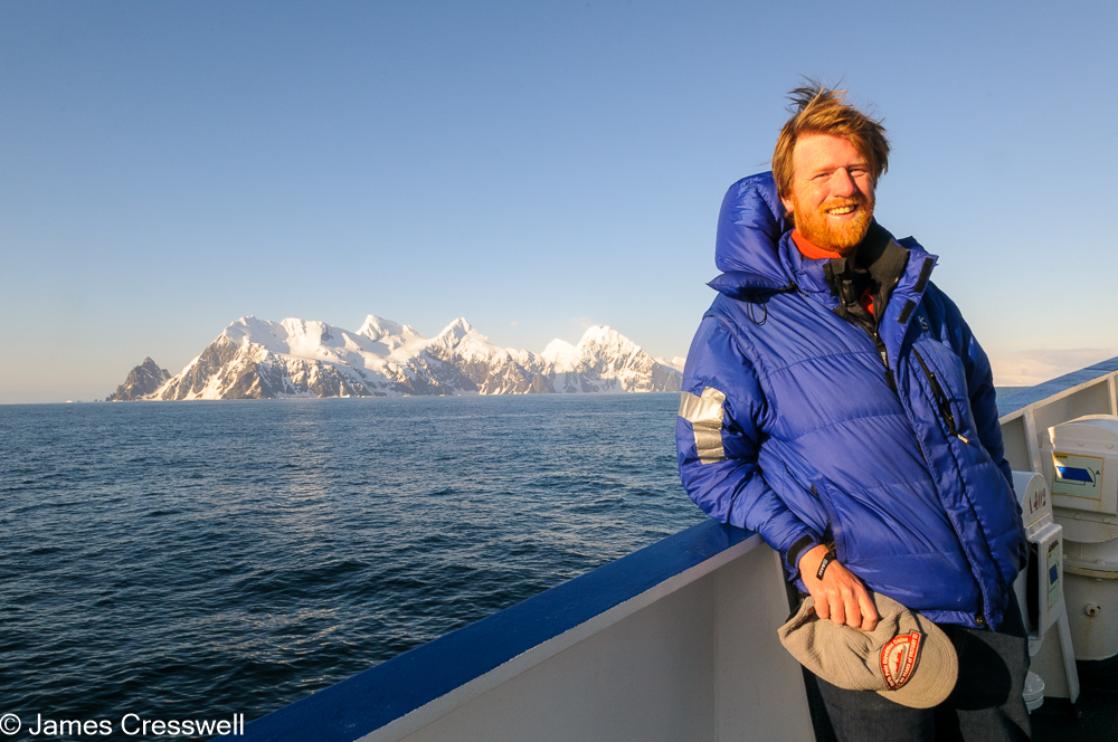
James Cresswell at Elephant Island, Antarctica
Watch James's presentation on the 'Geology of Antarctica'
James has guided thirty-eight Antarctic expedition cruises in his former career as a ship-wide geologist and expedition guide, before founding GeoWorld Travel. On this voyage, he will not be working for the cruise company; instead, he will be working directly for you, leading an exclusive GeoWorld Travel group, a dedicated sub-group within the ship’s total passenger complement. Drawing on his extensive Antarctic experience, James has carefully selected this voyage to maximize geological interest. In addition to the ship’s educational programme, he will provide the GeoWorld Travel group with a voyage geological handout, exclusive recaps, discussions, and in-field guidance. As your dedicated group leader, James can give far more personal attention than the ship’s geologist, who must divide their time across all passengers, ensuring that every landing and excursion is geologically rich and uniquely rewarding
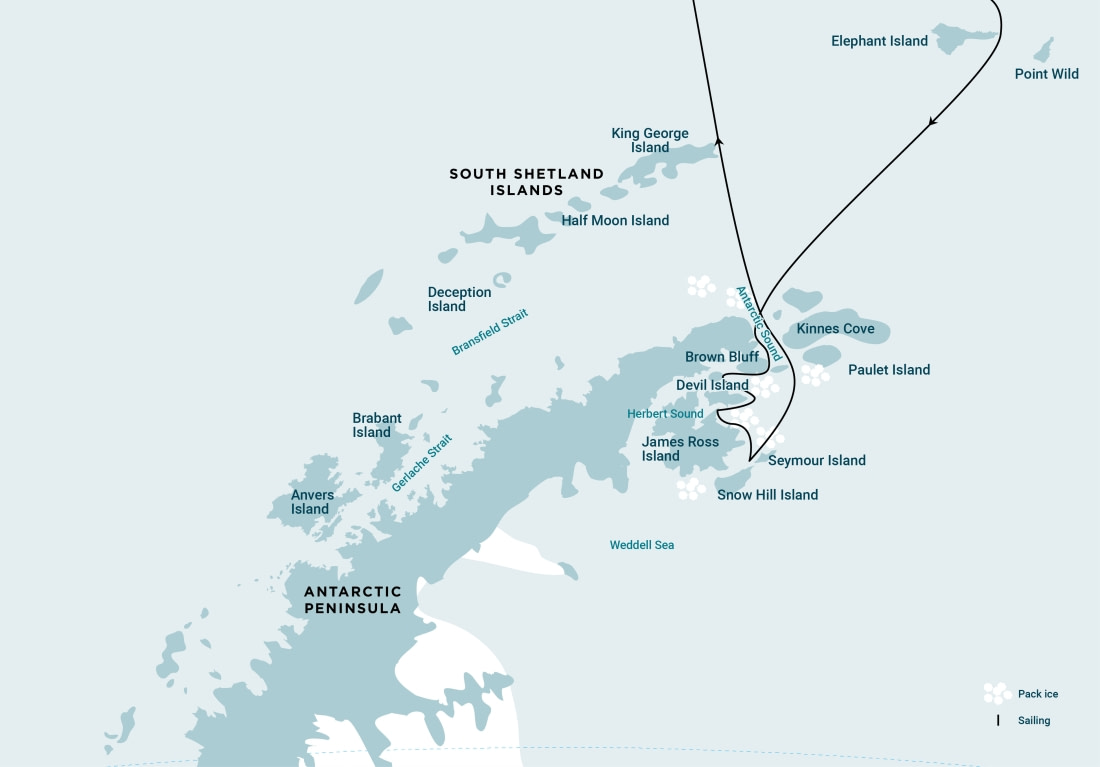
The Argentinian Esperanza Base, Hope Bay, Antarctic Sound
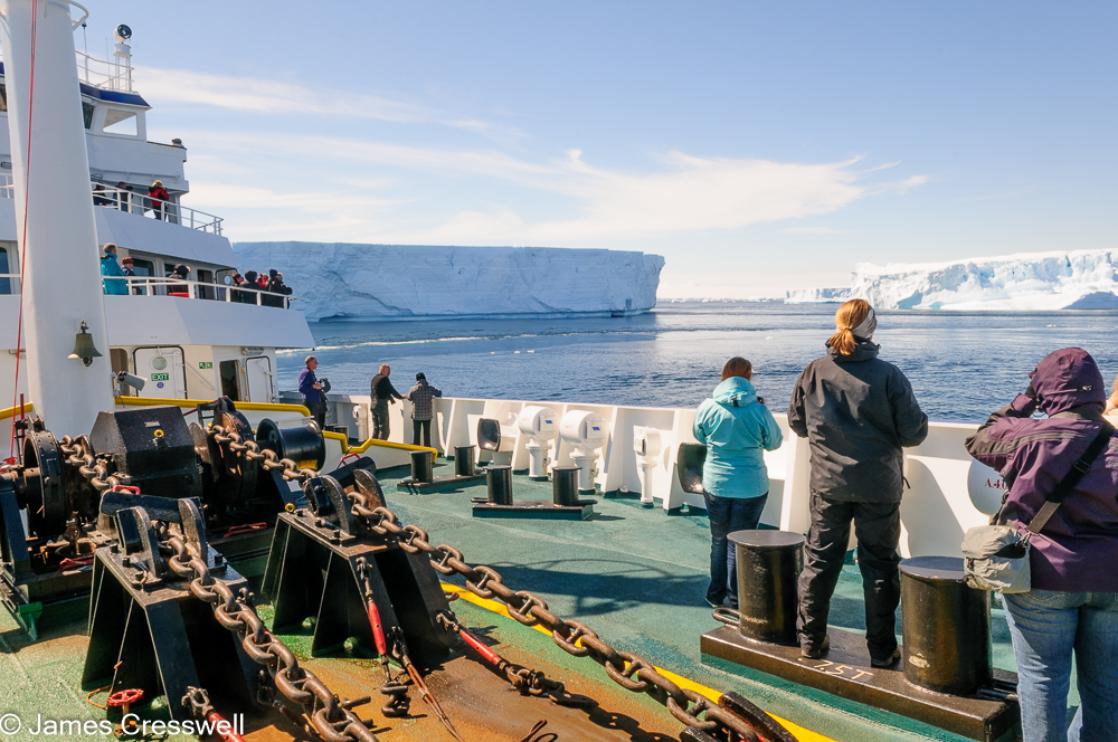
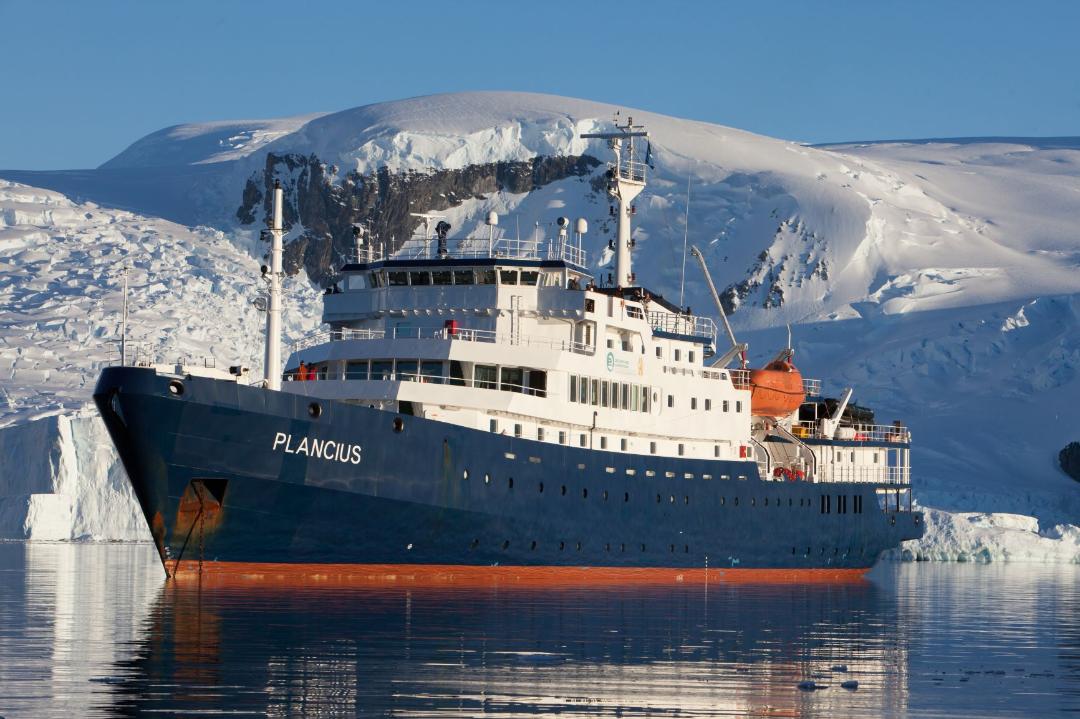
The m/v Plancius steers through huge tabular icebergs in Antarctic Sound
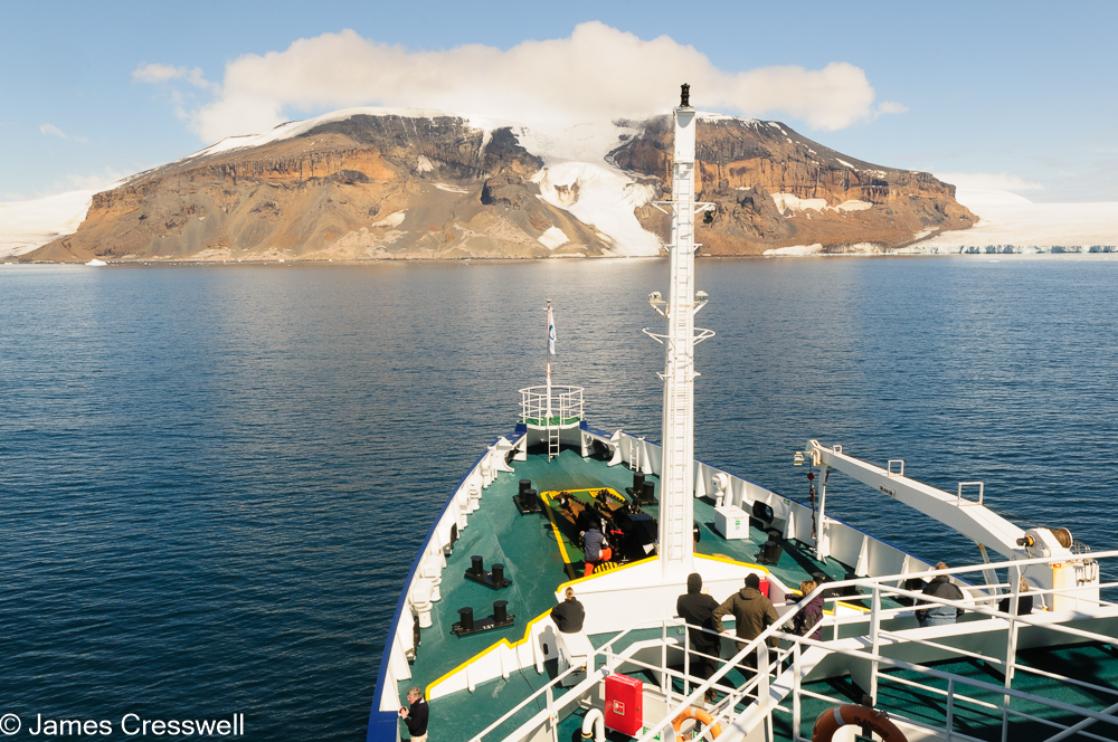
The m/v Plancius approaches the englacial volcano that is known as Brown Bluff, Antarctic Sound
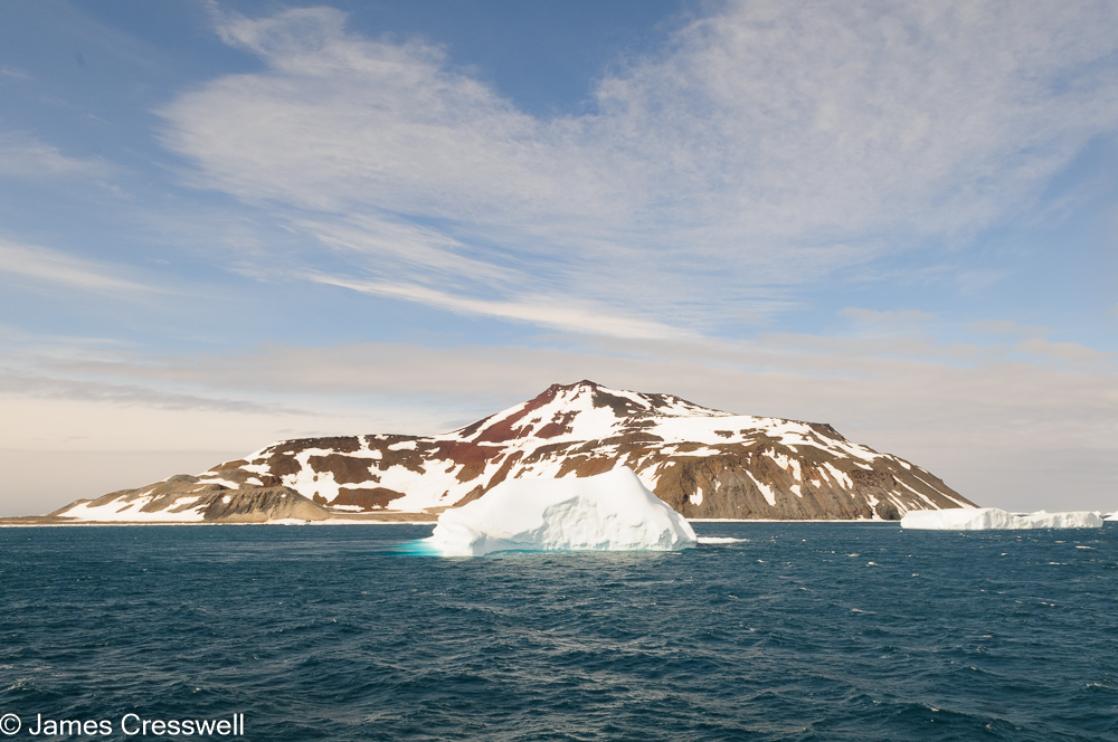
The active volcano - Paulet Island
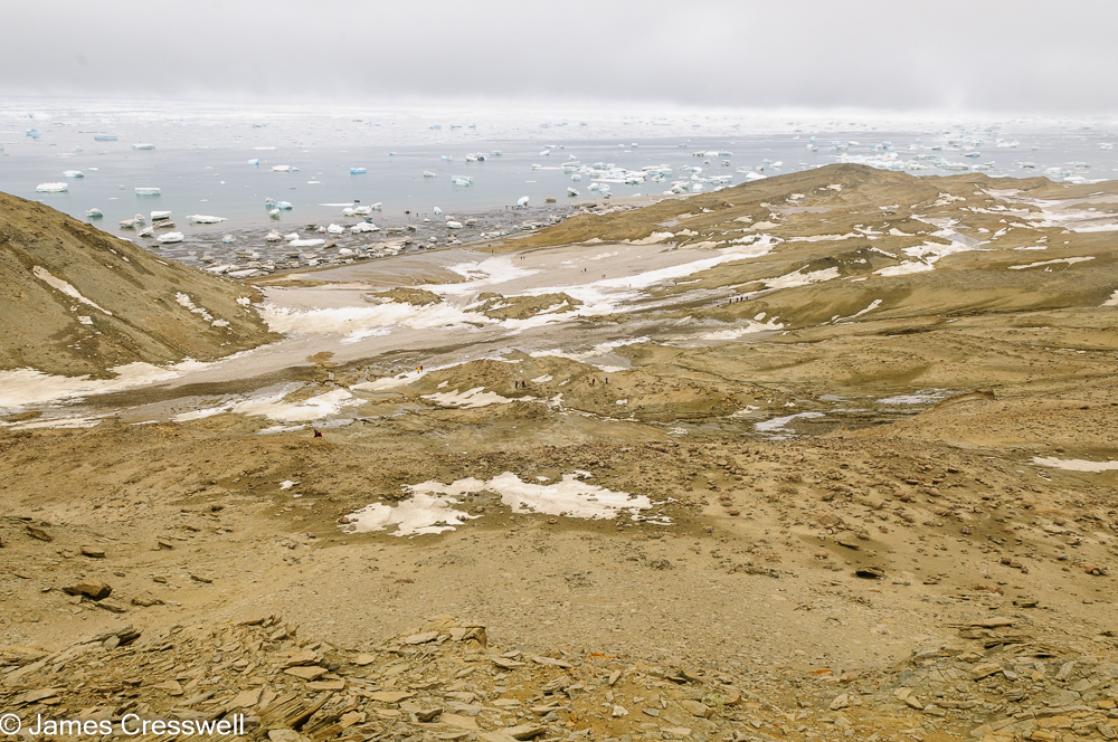
Seymour Island in the Weddell Sea. This island is usually snow free and is the most important palaeontological site inAntarctica

A colony of Adelie penguins on Devil Island, Weddell Sea
Possible Itinerary
Itineraries published by expedition cruise ships are always deliberately vague and general. This is because in Antarctica, weather and ice conditions dictate the exact route, meaning that while the general areas to be visited can be planned, the precise landings cannot be known in advance. Below is the published ship itinerary, with additional GeoWorld Travel notes added in black and italics.
Day 1: End of the world, start of a journey
Your voyage begins where the world drops off. Ushuaia, Argentina, reputed to be the southernmost city on the planet, is located on the far southern tip of South America. Starting in the afternoon, you embark from this small resort town on Tierra del Fuego, nicknamed “The End of the World,” and sail the mountain-fringed Beagle Channel for the remainder of the evening. Ushuaia lies on the Beagle Channel Fault System which is a segment of the Magallanes-Fagnano Fault. This is the plate boundary between the South American and Scotia plates.
Day 2 - 3: Path of the polar explorers
Not only does the marine life change, the avian life changes too. Wandering albatrosses, grey-headed albatrosses, black-browed albatrosses, light-mantled sooty albatrosses, cape pigeons, southern fulmars, Wilson’s storm petrels, blue petrels, and Antarctic petrels are a few of the birds you might see. The Drake Passage is the only place in the world where winds can blow uninterrupted around the entire planet. This has the effect of thermally isolating Antarctica and creating the highest average wave heights in the world.
Day 4: From Point Wild to the Weddell Sea
We will arrive early to the famous Point Wild, Elephant Island, where Shackleton’s crew made their first landing after the loss of their ship, Endurance. This inhospitable spit of land is a favourite among our guests, and if conditions permit, we will offer activities around the point before setting off for the Weddell Sea. The rocks of Elephant Island formed in an accretionary wedge at the boundary between the Scotia and Antarctic Plates. These intensely folded and faulted rocks — a mix of sedimentary, volcanic, and oceanic fragments — record the immense tectonic forces that shaped the region. Glacial erosion has since carved the island’s dramatic cliffs.
Day 5 - 8: Entering the Weddell Sea
The great Weddell Sea features massive tabular icebergs, wildly dramatic landscapes, and fascinating historical sites. It is also one of the best places in Antarctica for viewing iconic wildlife like whales, seals, and rarely seen seabirds.
We may visit the following locations, depending on local conditions:
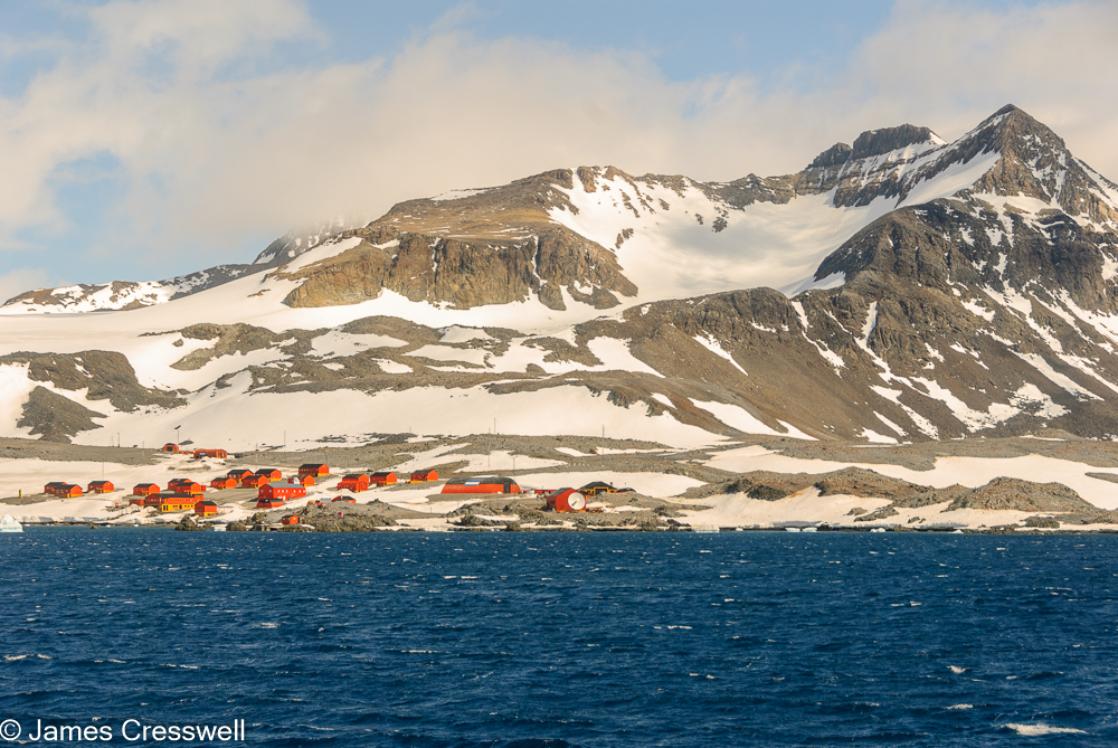
Antarctic Sound - Antarctic Sound is nicknamed “Iceberg Alley,” as we often see enormous tabular icebergs here. Antarctic Sound, or Iceberg Alley, is where massive icebergs calved from the Weddell Sea drift northward. Here, you’ll see icebergs far larger than those along the western Antarctic Peninsula.
Brown Bluff - Possibly the most scenic location in the northern Antarctic Continent, Brown Bluff is characterized by sheer canyon walls, fallen boulders, and beautiful volcanic creations capped with ice. Brown Bluff in Antarctic Sound is a classic tuya or table mountain, formed when lava erupted beneath thick Ice Age glaciers. Its steep, straight sides and flat top showcase the dramatic interaction of volcanism and ice, with layers of basalt, volcanic ash, and fragmented glass revealing the volcano’s subglacial origin. Today, its striking cliffs rising from the coast make it a spectacular natural landmark and a textbook example of Antarctic glacial volcanism.
Herbert Sound - We will focus our attention on the visually impressive areas of Naze Peninsula and Comb Ridge. Herbert Sound lies between the northeastern tip of the Antarctic Peninsula and James Ross Island, a roughly circular island that is essentially a single, enormous volcano — the largest volcanic complex in Antarctica. Its volcano was active mainly during the Late Cretaceous to early Paleogene, with eruptions as recent as ~1.6 million years ago. The sound itself is shaped by glacial erosion, carving fjord-like valleys and ice cliffs between the island and the mainland. James Ross Island is also famous for its exposed sedimentary rocks, which have yielded significant dinosaur fossil discoveries at the Naze Peninsula, providing a remarkable window into Antarctica’s prehistoric past.
Devil Island - This island offers a magnificent vantage point for hikers willing to foot it to the top of the hill. Melting ice sometimes forms a waterfall dropping from the cliffs close to Cape Well-met. Devil Island lies just off the northeastern coast of James Ross Island in the Antarctic Sound. Geologically, it is a fragment of the larger James Ross Island volcano, separated by glacial erosion and fjord formation during past ice ages. The island provides an excellent view of how glacial processes can isolate parts of a once-continuous volcanic edifice, creating striking coastal landscapes.
Erebus and Terror Gulf - Here we look for new activity opportunities and may visit Vega Island, experiencing the wilderness of Antarctica in its most remote places. Vega Island, at the entrance to Erebus and Terror Gulf, combines volcanic cliffs, glacially carved ridges, and Cretaceous fossil-bearing sediments. Here, dinosaur, plant, and invertebrate fossils sit alongside basaltic lava flows, offering a dramatic glimpse into Antarctica’s fiery, icy, and prehistoric past.
Other important geological location not mentioned in the ship's itinerary include: the active volcano of Paulet Island and palaeontological paradise of Seymour Island, both locations could also be contenders for landings depending on weather and ice conditions.
Day 9 - 10: Familiar seas, familiar friends
Your return voyage is far from lonely. While crossing the Drake, you’re again greeted by the vast array of seabirds remembered from the passage south. But they seem a little more familiar to you now, and you to them.
Day 11: There and back again
Every adventure, no matter how grand, must eventually come to an end. It’s now time to disembark in Ushuaia, but with memories that will accompany you wherever your next adventure lies.
Our Vessel: The M/v Plancius
Deck plans and downloads
m/v Plancius ship details
m/v Plancius deck plan
m/v Plancius cabins
M/v “Plancius” was built in 1976 as an oceanographic research vessel for the Royal Dutch Navy and was named “Hr. Ms. Tydeman”. The ship sailed for the Dutch Navy until June 2004 and was eventually purchased by Oceanwide Expeditions. The vessel was completely rebuilt as a passenger vessel in 2009 and complies with the latest SOLAS-regulations (Safety Of Life At Sea). M/v “Plancius” is classed by Lloyd’s Register and flies the Dutch flag.
Specifications
Passengers: 108 passengers in 50 cabins
Staff & crew: Crew 40 | Guides 8 | Doctor 1
Length: 89 meters (293 feet)
Breadth: 14,5 meters (47 feet)
Draft: 5 meters (16 feet)
Ice class: 1D (Plancius has a Lloyds class notation 100A1 Passenger ship, Ice Class 1D at a draught of 5 meters)
Displacement: 3211 tonnes
Propulsion: 3x Diesel-Electric
Speed: 10.5 knots average cruising speed
GeoWorld Travel Antarctic Cruise FAQ
Q: What is the name of the ship company we will be traveling with?
A: Oceanwide Expeditions.
Q: Will I book directly with GeoWorld Travel or with Oceanwide Expeditions?
A: Ultimately, you will book directly with Oceanwide Expeditions. However, your initial point of contact must be through GeoWorld Travel, and we will introduce you to Oceanwide Expeditions as part of our group.
Q: Does booking this GeoWorld Travel trip cost me any more than booking directly with Oceanwide?
A: No, it does not. GeoWorld Travel sells this trip at exactly the same price as Oceanwide Expeditions. GeoWorld Travel does, however, receive a commission from Oceanwide for arranging the booking.
Q: What is the advantage of having James on board to guide our exclusive group?
A: The advantage is that James can give the GeoWorld Travel group special, focused attention, providing far more geological information and guidance than the shipboard guides can, because they must look after the entire ship. While the shipboard guides will still support you, James offers additional time, insights, and personalized discussions for our group.
Q: Will there be other people on board besides the GeoWorld Travel group?
A: Yes. Our group will likely include 10–20 people, but there will be around 90 other passengers on board pursuing a variety of interests.
Q: Will the expedition staff give lectures to everyone?
A: Yes. The team will likely include a historian, an ornithologist, a marine mammal expert, and possibly a shipboard geologist, all providing lectures and insights to all passengers.
Q: Why is GeoWorld Travel choosing the Weddell Sea over the more commonly visited western Antarctic Peninsula?
A: James selected the Weddell Sea because it is far more geologically diverse and fascinating, offering volcanoes, fossil sites, and dramatic landscapes that are not seen on standard itineraries.
Q: What about Deception Island? Why aren’t we visiting this active volcano?
A: Deception Island is indeed an incredible geological destination. However, itineraries that include Deception Island typically follow the western Antarctic Peninsula, and it’s not possible to combine both Deception Island and the Weddell Sea. The volcanoes and geological highlights in the Weddell Sea more than make up for it.
Included in this voyage
-
All meals throughout the voyage aboard the ship including snacks, coffee and tea.
-
All shore excursions and activities throughout the voyage by Zodiac.
-
Program of lectures by noted naturalists and leadership by experienced expedition staff.
-
Free use of rubber boots and snowshoes.
-
Luggage transfer from pick-up point to the vessel on the day of embarkation, in Ushuaia.
-
Pre-scheduled group transfer from the vessel to the airport in Ushuaia (directly after disembarkation).
-
All miscellaneous service taxes and port charges throughout the programme.
-
Comprehensive pre-departure material.
Excluded from this voyage
-
Any airfare, whether on scheduled or charter flights.
-
Pre- and post- land arrangements.
-
Passport and visa expenses.
-
Government arrival and departure taxes.
-
Meals ashore.
-
Baggage, cancellation and personal insurance (which is strongly recommended).
-
Excess baggage charges and all items of a personal nature such as laundry, bar, beverage charges and telecommunication charges.
-
The customary gratuity at the end of the voyages for stewards and other service personnel aboard (guidelines will be provided).